
Every business begins with an idea.
Someone sees an opportunity, believes they can do something better, and decides to take the risk of building a company. That moment, when someone commits to turning an idea into reality, is the true beginning of entrepreneurship.
From that point forward, the entrepreneur enters a world that is exciting, uncertain, and often lonely. Decisions must be made with incomplete information. Problems appear daily. Responsibilities pile up faster than time allows.
Many entrepreneurs believe their business is unique and that the rules that apply to other companies somehow do not apply to them.
But the truth is much simpler.
Regardless of industry, whether you run a landscaping company, a law firm, a gym, a restaurant, a construction business, a medical practice, a consulting firm, or a technology company, every business faces the same fundamental challenges.
-
Someone must generate customers.
-
Someone must deliver the work.
-
Someone must manage the finances, risk, and operations behind the work.
The difference between businesses that remain small and those that grow into scalable organizations is often not the industry. It is the mindset of the entrepreneur leading them.
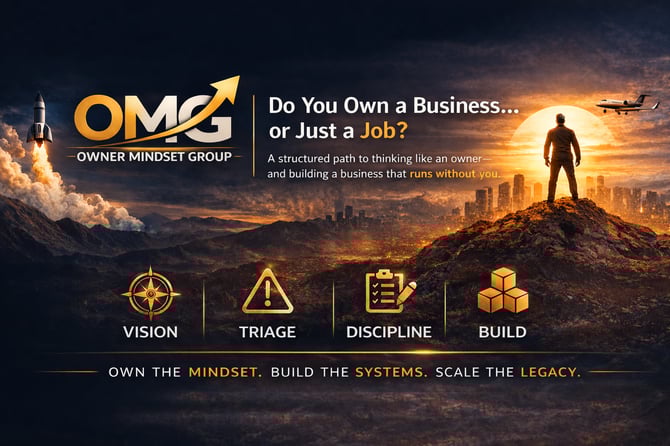
The Entrepreneurial Mindset Framework breaks that mindset into four essential elements:
-
Vision ▶️ Triage ▶️ Discipline ▶️ Build.
Vision
Every business starts with vision.
The entrepreneur sees something others do not. They imagine a product, service, or experience that could exist if they are willing to pursue it.
Vision provides the courage to begin and the direction that guides early decisions.
But vision must extend beyond the original idea. As the business grows, the entrepreneur must continue asking larger questions:
-
Where should this business be in five years?
-
What type of organization are we building?
-
What kind of team do we want to create?
Without ongoing vision, the entrepreneur becomes trapped in daily operations and the business loses its long-term direction.
Triage
Starting and running a business requires constant prioritization.
There are always more things that should be done than time, money, or resources allow. Legal issues, financial management, hiring decisions, marketing, operational improvements, and risk management all compete for attention.
Entrepreneurs quickly learn a difficult truth:
If they attempted to do everything “perfectly” at the beginning, they might never survive long enough to grow.
Instead, they practice triage, assessing what must be done now, what can be delayed, and what can safely be ignored for the moment.
Triage is not a sign of poor leadership. It is a necessary survival skill in the early stages of building a business.
However, triage must remain temporary.
The responsibilities that were postponed must eventually be addressed if the company is going to mature into a stable organization.
Discipline
As a business stabilizes, the entrepreneur must begin replacing improvisation with discipline.
Discipline means establishing consistent ways of operating the company. This includes documenting processes, defining responsibilities, managing finances carefully, and setting clear expectations for performance.
Discipline transforms a business from something that depends entirely on the owner's effort into something that can operate consistently over time.
This is also the stage where many entrepreneurs discover that they do not need to invent every solution themselves.
Successful companies often rely on proven business frameworks, leadership systems, and operational models developed by others. Learning when to use those tools and when to set them aside is part of the discipline of business leadership.
Build
Eventually, every entrepreneur must confront the most important transition in the life of a business.
They must stop trying to do everything themselves and begin building an organization.
Building means developing people, creating systems, and establishing leadership structures that allow the company to operate beyond the limits of a single individual.
This shift is rarely easy. Many founders have spent years solving problems personally, protecting quality through their own effort, and making every important decision.
But sustainable businesses are not built on individual heroics.
They are built by leaders who invest in teams, processes, and shared accountability.
The Mindset Behind Scalable Businesses
The Entrepreneurial Mindset Framework does not suggest that entrepreneurship becomes easier over time. In many ways, the challenges become larger as the business grows.
But entrepreneurs who embrace Vision, practice Triage wisely, apply Discipline consistently, and commit to Building teams and systems create companies that can grow beyond the limits of their personal effort.
These are the businesses that evolve from Stage 1 owner-operated companies into scalable organizations capable of long-term success.
The goal is not perfection.
The goal is progress—one decision, one process, and one team member at a time.
NEXT UP: Stage 1 Business Modeling
Where are you in the journey?