
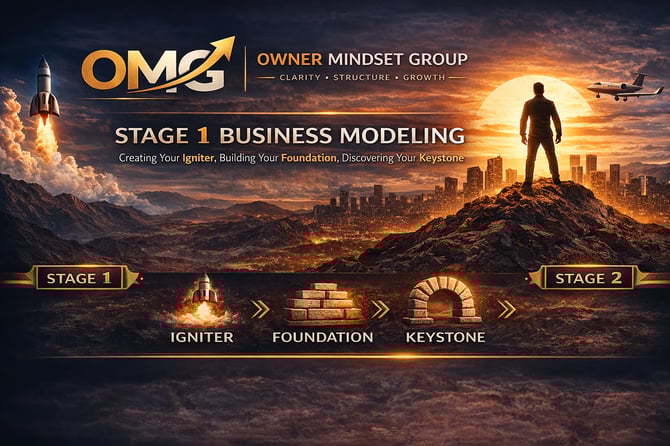
Stage 1 Business Modeling
Stage 1 businesses are typically owner-led companies with one to three employees where the founder remains deeply involved in daily operations. In these companies, the owner's time, decisions, and personal effort are the primary drivers of performance.
This stage of business ownership is common, but it is often misunderstood. Many entrepreneurs assume they must either remain permanently small or immediately pursue aggressive growth. In reality, most businesses evolve through several distinct phases before they are ready to scale.
Stage 1 Business Modeling helps owners understand where they are in that journey and what must happen for the business to grow beyond the limits of a single individual.
The Three Types of Stage 1 Businesses
Stage 1 businesses generally fall into three categories.
Igniter Business
An Igniter Business is proving its model. The company has begun generating revenue, but operations, pricing, and processes are still being refined.
Typical signs include:
-
inconsistent revenue patterns
-
the owner performing most operational roles
-
informal or undocumented processes
-
ongoing adjustments to services or pricing
The goal of this stage is to establish a reliable and repeatable business model.
Foundation Business
A Foundation Business is stable and proven.
The company has established consistent revenue, reliable customers, and predictable operations. At this stage, the business is no longer experimenting; it is delivering dependable results.
Typical characteristics include:
-
consistent customer demand
-
stable pricing and service offerings
-
predictable operational routines
-
a small but dependable team
Foundation businesses can operate successfully for many years, but they should still be built with systems that allow future growth if desired.
Keystone Business
A Keystone Business has reached the limits of the owner-operated model.
Demand exists and the business is profitable, but growth begins to slow because the owner cannot personally handle every responsibility.
Keystone businesses typically show four signals:
-
Growth-Impacted – opportunity exceeds the owner’s capacity
-
Delegation-Saturated – most tasks that can be delegated already are
-
Financially Sound – margins support hiring and expansion
-
Leadership-Ready – the owner must shift from operator to leader
At this stage, the owner must decide whether to activate the systems and leadership required for Stage 2 growth or intentionally stabilize the business while protecting quality of life.
Why This Framework Matters
Most small businesses struggle not because of poor products or lack of effort, but because they grow beyond the limits of the owner's time without developing the systems required to scale.
Stage 1 Business Modeling helps owners recognize when that moment arrives and prepares them to build the leadership, processes, and teams required for the next phase of growth.
The following articles explore each part of this journey and the practical steps that help businesses evolve from owner-operated companies into scalable organizations.
NEXT STEP: Business Modeling Framework Overview
Understand where your are and where you want to be!