
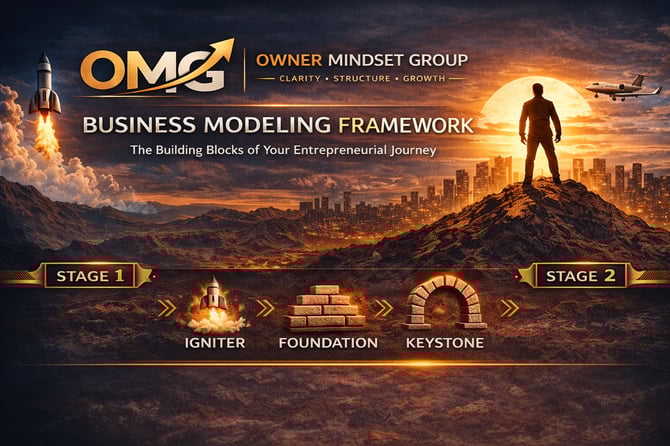
Business Modeling Framework Overview
Most business advice focuses on either startups or large organizations. Yet millions of companies operate in the middle ground—profitable, established businesses that are still heavily dependent on their founders.
These companies are not experimental startups, and they are not yet structured organizations. They are Stage 1 businesses.
Understanding how these businesses develop is essential for entrepreneurs who want to build companies that grow beyond the limits of a single individual.
The Stage 1 Progression
Stage 1 businesses typically evolve through three phases.
Igniter → Foundation → Keystone
Each phase represents a different level of maturity, stability, and leadership responsibility.
-
Igniter – proving the business model
-
Foundation – stabilizing operations and revenue
-
Keystone – reaching the limits of owner-operated growth
This progression is not about size alone. It reflects how the business functions internally and how leadership responsibilities evolve as the company grows.
Stage 1 Business Modeling Framework
Entrepreneur Vision
│
▼
IGNITER
(Prove the Business Model)
│
▼
FOUNDATION
(Stabilize the Business)
│
▼
KEYSTONE
(Owner Capacity Ceiling)
│
┌───┴───────────────┐
▼ ▼
Lifestyle Keystone Stage 2 Business
(Control Growth) (Scale Through Systems)
Stage 1 Business Modeling Framework
This framework illustrates how owner-led businesses evolve from proving their model to stabilizing operations and ultimately deciding whether to scale into a Stage 2 organization.
The Keystone Decision
The Keystone stage represents the most important crossroads in the life of a small business.
At this point, the company is profitable and respected, but growth opportunities begin exceeding the owner's capacity to personally manage every responsibility.
Business owners must decide whether to:
-
intentionally stabilize the company and protect a lifestyle business, or
-
build the leadership structure and systems required for Stage 2 growth
The key difference is that this choice should be intentional, not the result of structural limitations.
What Stage 2 Looks Like
Stage 2 businesses operate through systems and teams rather than the owner's personal effort.
Typical characteristics include:
-
four or more employees
-
revenue capacity exceeding $1 million
-
documented operational processes
-
delegated leadership responsibilities
-
the owner focused primarily on strategy, relationships, and direction
When these elements are in place, the business can grow beyond the physical limits of the founder’s time.
Building a Business That Can Scale
The purpose of Stage 1 Business Modeling is not simply to describe small businesses—it is to help owners build companies capable of growth.
That requires developing:
-
repeatable processes
-
capable teams
-
clear leadership structures
-
strong operational discipline
The articles in this framework explore how entrepreneurs navigate each stage and prepare their businesses for the transition from owner-operated companies to scalable organizations.
NEXT STEP: Becoming a Foundation Business
Addressing Ignitors, discover the path to a solid Foundation Business you can build your enterprise on!